Last week, over breakfast, my daughter was planning a party and let out a sigh: “I’m so stressed about everything that could still go wrong and everything that isn’t done yet.” My partner looked up from his plate and said, quite calmly: “Stress is a choice.”
She stared at him. I said: “Wow, that’s a bold statement. But it’s true.”
That line stayed with me. It’s an uncomfortable one, and in my work I see every day how much truth there is in it.
What you say every day, your body starts to believe
Plenty of us say it daily, almost like a mantra: “I’m so stressed.” “My life is so stressful.” It slips out by the coffee machine and in the school parents’ WhatsApp group. The more you repeat it, the more you feed it.
The Dutch psychologist Jos Brosschot studied what happens in your body when you keep playing the same worry story on repeat. Often the event itself wears you down less than the worrying about it. As long as your mind keeps chewing on something, your body stays in stress mode, long after the cause has passed. Your heart rate, muscle tension and stress hormones never get the chance to settle. The chat with your manager lasted ten minutes, yet your body is still working through it at bedtime.
The way I see it: the moment you hide behind your stress, you make things harder for yourself. “I’m just so busy” becomes the explanation for everything that isn’t working. And you give away the power you have.
Stress doesn’t have to be the enemy
What you believe about stress itself matters too. In a large American study, Abiola Keller and colleagues followed almost 29,000 adults for eight years. People who had a lot of stress and also believed stress was bad for their health had a 43% higher risk of dying during that time. People with just as much stress who didn’t hold that belief had the lowest risk of any group, lower even than people with very little stress.
It’s an observational study, so it doesn’t prove cause and effect. But it fits with what the psychologist Alia Crum showed in experiments at Stanford: people who learned to see stress as something that can sharpen and strengthen them felt better under pressure and performed better than people who saw it purely as a threat. When your heart speeds up before a presentation, your body is getting blood and oxygen ready for what’s coming.
Even when it’s genuinely hard
Sometimes you don’t choose the cause. A sick child, a loss, a war, a job you can’t just walk out of because the rent needs paying. That stress is real, and it’s allowed to be there. If it gets too much, you haven’t done anything wrong.
The Viennese psychiatrist Viktor Frankl survived the concentration camps and went on to write, in Man’s Search for Meaning, that there is one thing nobody can take from you: the freedom to choose how you respond to your circumstances. He added something important. If you can change or remove what’s causing your stress, do that. Choosing your attitude is for what you can’t change.
Work out exactly what you’re feeling
“I’m stressed” doesn’t tell you much about what’s actually going on inside. In a study by the American psychologist Matthew Lieberman and colleagues, the brain’s alarm centre, the amygdala, calmed down as soon as people put their feelings into words. The more precisely you know what you’re feeling, the more you can do with it.
Naming a feeling and repeating it are two different things. Saying once, precisely, what you feel brings calm. Saying “I’m so stressed” ten times a day is exactly the worrying Brosschot wrote about. Researchers around Lisa Feldman Barrett also found that people who can tell their feelings apart in finer detail cope with them better. “I’m scared I’m not doing this well enough” gives you something to work with. “I’m stressed” gives you very little.
This is the exercise I do with people who come to me with stress. You’ll also find it, ready to save or print, in my free training The stress break. Give yourself ten minutes somewhere you won’t be disturbed.
Feel where it sits. Close your eyes. Where in your body do you feel the stress? Pin down the spot as precisely as you can and breathe into it. Does it have a colour? A texture? Is it soft or hard, warm or cold? Finnish researchers led by Lauri Nummenmaa asked hundreds of people to mark where in their body they felt different emotions. Each emotion turned out to have its own recognisable place. Fear tended to sit in the chest, anger in the arms and head.
Find the emotion. Is there an emotion attached? Often it’s fear, the sense of not being good enough, or the fear of being laughed at. Is there another feeling underneath? Quite often anger comes up. Sometimes it’s the other way round, and something else is hiding under the anger.
When did you first feel this? Let a memory come up. For me it was a talk I had to give at school. I was so nervous that morning I couldn’t eat a thing. Halfway through, my stomach started rumbling loudly and the whole class burst out laughing, the teacher too. Even my best friend joined in. I felt completely let down.
A feeling like that is often an echo of an old situation. We keep replaying the echo because we’ve never really looked at what happened back then. It’s how someone of forty, about to give a presentation, can suddenly feel ten again, stomach already lodging a complaint.
Rewrite the memory. Go back to that moment as if you had a time machine, and change what happens. I picture myself at the breakfast table again, and this time I eat my breakfast. I walk to school, give my talk, and my stomach stays quiet. Imagine it as vividly as you can, with the smells, sounds and feelings, and run through it a few times.
Psychologists call this imagery rescripting. Across nineteen studies (Morina, Lancee and Arntz, 2017), people were far less troubled by their memory afterwards. What happened back then still happened. What shifts is how the memory feels, and what it says about you.
In my practice I notice that this works best when someone is willing to let go of the role that once grew up around that memory. Research points the same way: the more a painful memory becomes the centre of who you are, the more it keeps weighing on you (Berntsen and Rubin, 2006). I wrote about those roles in The 5 GOOD. minutes on your role as a child.
Is it a heavy or traumatic memory? Then don’t take this step on your own; do it with a psychologist or therapist who works with this.
From worry to excitement
At the breakfast table we gave my daughter two pieces of advice.
First: make a plan instead of brooding over what might go wrong. What have I already got? What’s still missing? Who can I ask for help? A plan gets the loose ends out of your head and onto paper. It works even better as an if-then sentence: “If I haven’t heard from the bakery by four on Friday, I’ll ring them.” Pooling 94 studies, Peter Gollwitzer and Paschal Sheeran showed that people with an if-then plan like that follow through far more often than people who only have a goal.
Second: give the feeling a different name. In a study by Alison Wood Brooks at Harvard, people about to do something nerve-racking, like singing karaoke or giving a speech, said “I am excited” out loud instead of trying to calm down. They did better afterwards. Nerves and excitement feel almost the same in your body: your heart beats faster and you’re alert. It’s easier to steer that energy somewhere new than to slam the brakes on.
You can also talk to yourself using your own name: “Tanja, you’ve got this.” Across seven studies by the psychologist Ethan Kross, people who addressed themselves like that felt calmer, performed better and dwelt on it less afterwards. It puts a little distance between you and the moment, the way you’d look at a good friend.
Start with your breath

When the stress is already there, your breath is the quickest thing to reach for. Breathe in through your nose and top it up with one more little sip of air at the end. Then breathe out slowly and fully through your mouth. It’s called cyclic sighing, and your body does it on its own a few times an hour without you noticing.
In a study by researchers at Stanford (Balban and colleagues, 2023), people did five minutes of a breathing exercise every day for a month. Cyclic sighing gave their mood the biggest lift, more than for people who spent the same five minutes meditating. On The stress break there’s a moving circle to help you breathe along at the right pace.
Your body has a say too
A blood sugar dip often feels like restlessness: shaky, irritable, heart racing. Your body releases the same stress hormones as when you’re tense, such as adrenaline and cortisol. Cortisol comes from your adrenal glands and gets extra sugar into your bloodstream fast, so you’re ready for action. In the short term, that’s exactly what you need. But if your cortisol stays high all day, your body gets stuck in that ready-for-action mode, and you often sleep worse.
It works the other way round too: stress makes you crave sweet and fatty food, as the researcher Elissa Epel found back in 2001. Women whose cortisol shot up during a stressful task ate noticeably more sweet and fatty snacks afterwards. It feels like relief for a moment, then your blood sugar drops again and the whole cycle starts over. Reaching for the biscuit tin when you’re stressed is simply your hormones having their say.
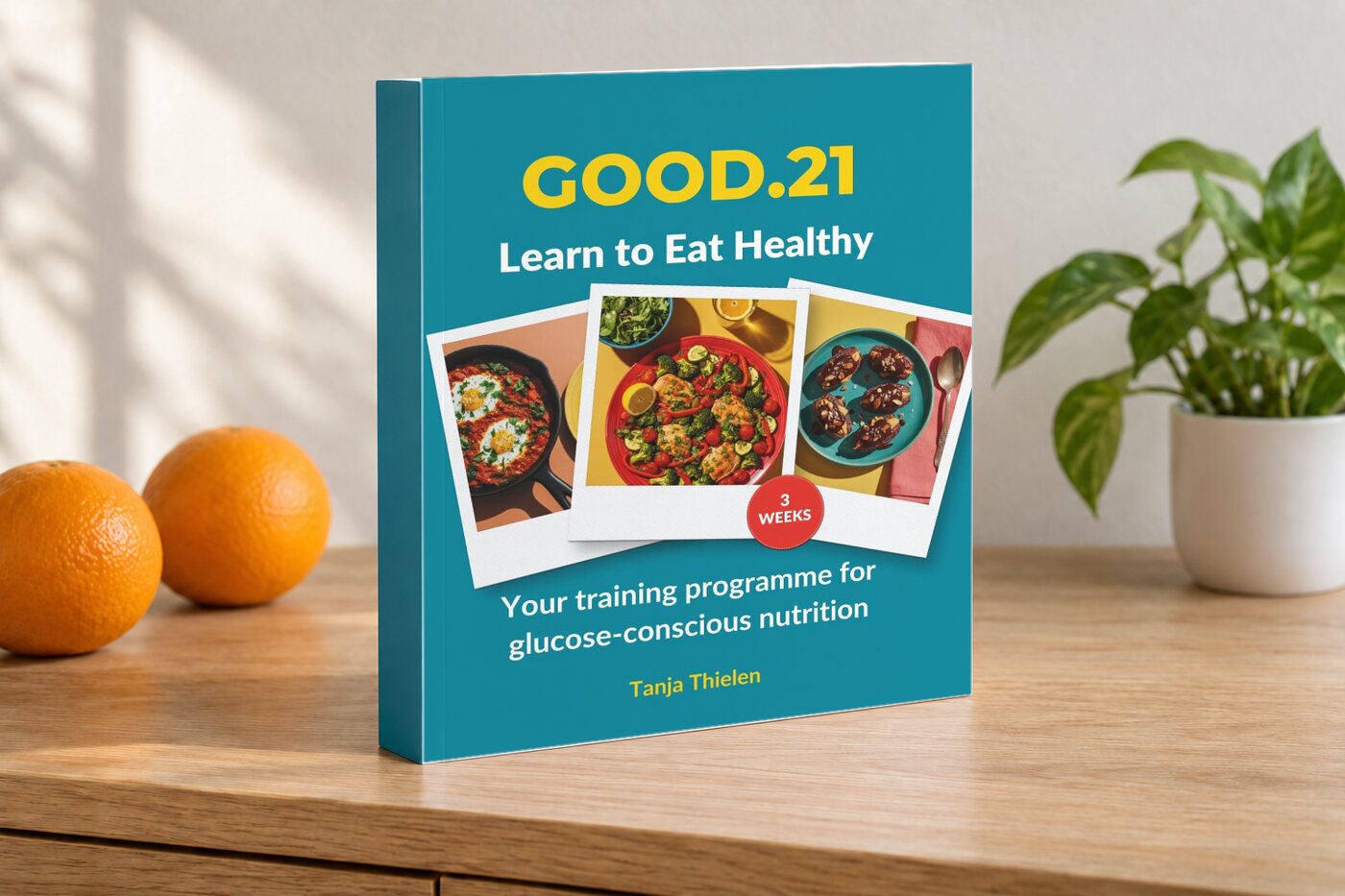
In my book GOOD.21 I show you how to keep your blood sugar steady. Three things you can start today: begin breakfast with protein, eat your veg first, and in a busy week skip that three o’clock coffee. Caffeine pushes your cortisol up on top of everything the day has already done, even if you’re a seasoned coffee drinker.
What you eat shows up in your head over the longer term as well. In the SMILES trial led by Felice Jacka, adults with depression were supported for twelve weeks to eat a Mediterranean-style diet. By the end, 32% had recovered, compared with 8% in the group who only had supportive conversations. It was a small study, but the first to test this so carefully.
I see nutrient gaps as quiet microstress: you don’t notice them, but your body does. That’s why I often recommend VMG+ as a foundation, a sachet you dissolve in water, or the pill-free bundle for a complete foundation, including omegas and probiotics. There’s a lovely study on omega-3 with medical students during exam season: those who took omega-3 for twelve weeks had 20% less anxiety than the group on dummy capsules (Kiecolt-Glaser and colleagues, 2011).
Your muscles make you more resilient

A large review in the British Journal of Sports Medicine pooled more than a thousand studies with over 128,000 people: those who moved had noticeably less low mood, anxiety and stress. The more intense the movement, the bigger the effect. Strength training did well too: in a review by Brett Gordon and colleagues, symptoms of depression eased whether or not people got visibly stronger.
Your brain grows with you. In a study by Kirk Erickson, older adults walked regularly for a year and their memory centre grew by around 2%, winding back one to two years of natural shrinkage. Exercise also raises BDNF, a signalling substance that helps your brain build new connections. That makes it easier to adapt when life suddenly heads off in a different direction.
You don’t need to run a marathon. In a study of 191,000 people, just an hour of brisk walking a week was linked to an 18% lower risk of depression. Ten minutes after lunch or twenty squats while the kettle boils, it all counts. You’ll find movements to follow along with on my page GOOD. moves.
The stress break, a free training
For the moments when you feel the stress rising, I’ve made The stress break: a breathing exercise you follow on screen, the exercise to work out exactly what you’re feeling, and what you can do in the minutes that follow, from finding five beautiful things outside to getting a plan down on paper. Keep the page on your phone, or print it out and stick it on the fridge.
Is the stress hanging around, or getting genuinely too much? Talk to someone you trust, or to your GP.
Sources
- Brosschot, Gerin and Thayer (2006). The perseverative cognition hypothesis. Journal of Psychosomatic Research. PMID 16439263
- Keller and colleagues (2012). Does the perception that stress affects health matter? Health Psychology. PMID 22201278
- Crum, Salovey and Achor (2013). Rethinking stress: the role of mindsets in determining the stress response. Journal of Personality and Social Psychology. doi.org/10.1037/a0031201
- Frankl, V. (1946/2006). Man’s Search for Meaning.
- Lieberman and colleagues (2007). Putting feelings into words. Psychological Science. PMID 17576282
- Kashdan, Barrett and McKnight (2015). Unpacking emotion differentiation. Current Directions in Psychological Science. doi.org/10.1177/0963721414550708
- Nummenmaa, Glerean, Hari and Hietanen (2014). Bodily maps of emotions. PNAS. PMID 24379370
- Morina, Lancee and Arntz (2017). Imagery rescripting as a clinical intervention for aversive memories: a meta-analysis. Journal of Behavior Therapy and Experimental Psychiatry. PMID 27855298
- Berntsen and Rubin (2006). The centrality of event scale. Behaviour Research and Therapy. PMID 16389062
- Gollwitzer and Sheeran (2006). Implementation intentions and goal achievement: a meta-analysis of effects and processes. Advances in Experimental Social Psychology.
- Brooks (2014). Get excited: reappraising pre-performance anxiety as excitement. Journal of Experimental Psychology: General. PMID 24364682
- Kross and colleagues (2014). Self-talk as a regulatory mechanism: how you do it matters. Journal of Personality and Social Psychology. doi.org/10.1037/a0035173
- Balban and colleagues (2023). Brief structured respiration practices enhance mood and reduce physiological arousal. Cell Reports Medicine. PMID 36630953
- Epel and colleagues (2001). Stress may add bite to appetite in women. Psychoneuroendocrinology. PMID 11070333
- Lovallo and colleagues (2005). Caffeine stimulation of cortisol secretion across the waking hours. Psychosomatic Medicine. PMID 16204431
- Jacka and colleagues (2017). A randomised controlled trial of dietary improvement for adults with major depression (SMILES). BMC Medicine. doi.org/10.1186/s12916-017-0791-y
- Kiecolt-Glaser and colleagues (2011). Omega-3 supplementation lowers inflammation and anxiety in medical students. Brain, Behavior, and Immunity. PMID 21784145
- Singh and colleagues (2023). Effectiveness of physical activity interventions for improving depression, anxiety and distress. British Journal of Sports Medicine. PMID 36796860
- Gordon and colleagues (2018). Association of efficacy of resistance exercise training with depressive symptoms. JAMA Psychiatry. PMID 29800984
- Erickson and colleagues (2011). Exercise training increases size of hippocampus and improves memory. PNAS. PMID 21282661
- Pearce and colleagues (2022). Association between physical activity and risk of depression. JAMA Psychiatry. PMID 35416941