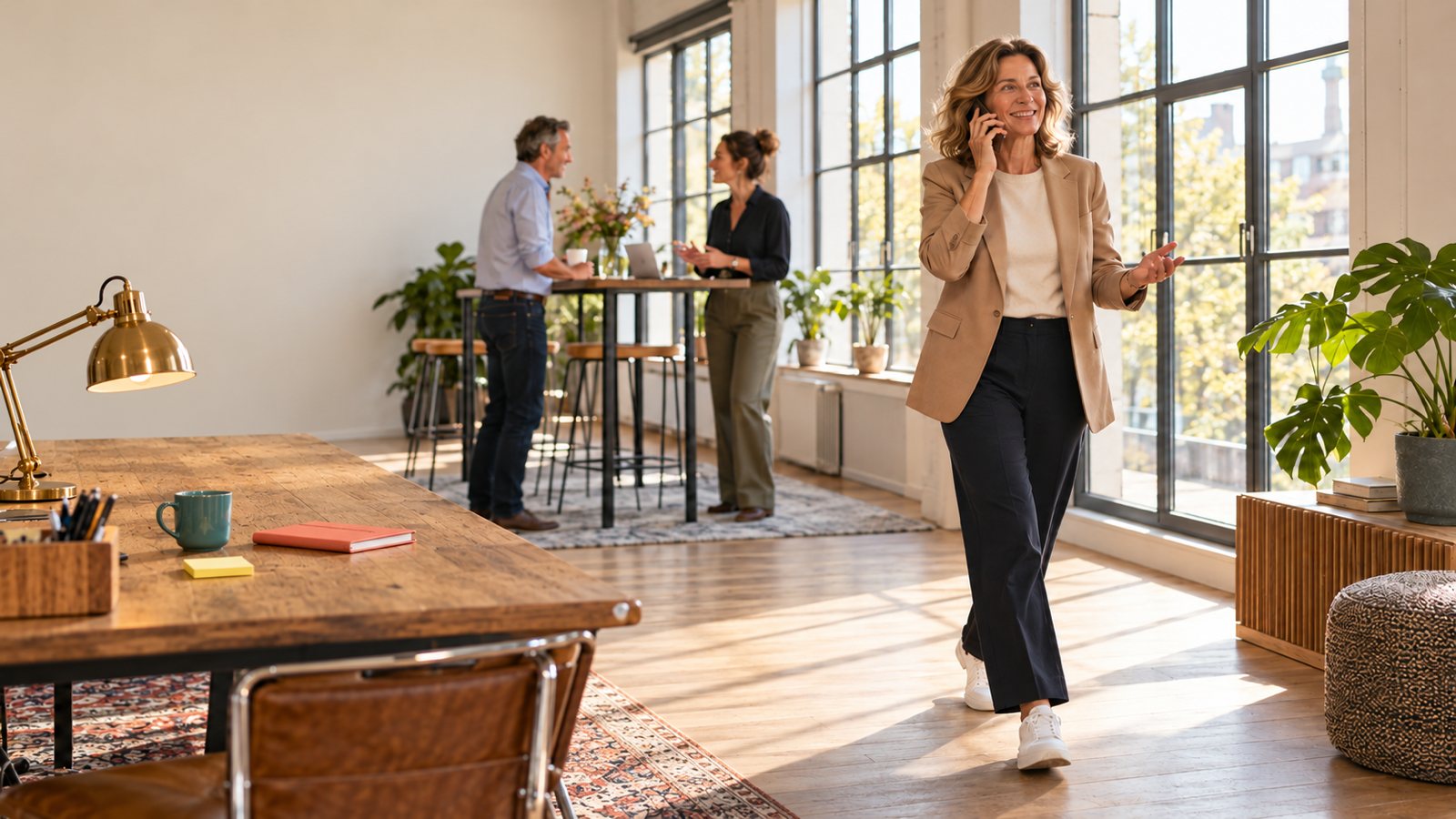
A woman walks past the window of a bright office while on the phone, with two colleagues talking behind her
For anyone who works at a screen

GOOD. moves

Two minutes of movement every 30 minutes. Twelve exercises you can do in your work clothes, with a timer. Free, and you can start right now.

You've probably sat more than you've walked today. You'll feel it at three o'clock: a heavy head, stiff shoulders and a craving for something sweet.

With GOOD. moves, you get up for 2 minutes every 30 minutes, or move under your desk. Twelve exercises you can do in a suit, a skirt or heels, in an open-plan office or at the kitchen table. Nobody will notice four of them. Pick one, start the timer and add a ✓ to your tracker.

What's in it for you

Less of an afternoon slump

Break up your sitting every 20 minutes with 2 minutes of walking, and your blood sugar stays flatter after eating than if you stay put.

Dunstan 2012

More ideas

On your feet, you come up with well over 50% more new ideas than sitting down.

Oppezzo & Schwartz, Stanford 2014

A body that keeps going

Two minutes a day of targeted neck and shoulder exercise gave office workers fewer complaints after 10 weeks.

Andersen 2010

A habit that sticks

Move for something you'll notice the same day, like a clear head at three o'clock. You'll keep that up for longer than moving for some distant future.

Segar 2011

How to start

  1. Pick an exercise below, or let the site choose one for you, and start the 2-minute timer.
  2. Print the tracker and add a ✓ every 30 minutes.
  3. Turn your lunch into the GOOD. lunch break: away from your desk, eat in the right order and spend fifteen minutes outside.
  4. Bring a colleague. Every exercise comes with a line you can use.

The 12 exercises

Choose an exercise yourself, or let the site pick one for you.

Start with 2 minutes, build up to 5

Start with 2 minutes every 30 minutes. It fits around any diary, and it already helps. In a study by Dunstan and colleagues, people walked gently for 2 minutes every 20 minutes, and their blood sugar and insulin rose clearly less after a meal than when they sat still. Dunstan 2012

Once you're in the rhythm, make it 5 minutes. In a study by Duran and colleagues comparing four different movement breaks, walking for 5 minutes every half hour had the biggest effect on blood sugar. Duran 2023

Download the tracker (PDF)

Nobody notices Even on a call.

Heel raises

Heel raises

Feet flat, toes stay down, heels up and down for 2 minutes. Your calves do the work, even mid-call.

Tip: Toes stay down, nice and steady. If your calf burns, you're doing it right.

What it does

Your deep calf muscle pulls sugar and fat out of your blood while you carry on working. In the study, people kept this up for hours; 2 minutes is your starting point. Hamilton et al. 2022

Say to a colleague: “I'm doing strength training under the table: heels up and down, toes stay put. Nobody can see, so join in. At least we'll have achieved something in this meeting.”

Glute squeeze

Glute squeeze

Squeeze your glutes for 5 seconds, let go, and keep that up for 2 minutes. Your chair will know. Nobody else will.

Tip: Back straight and keep breathing. Holding your breath doesn't count.

What it does

In a study, working big muscles during long spells of sitting improved blood sugar and blood pressure after a meal. Dempsey et al. 2016

Say to a colleague: “Secret workout: squeeze your glutes for 5 seconds, let go, repeat. Nobody can tell. Whoever keeps a straight face longest wins.”

20-20-20

20-20-20

Every 20 minutes, look at something 20 metres away for 20 seconds. Your eyes need a break too.

Tip: Really look into the distance, ideally outside, and blink properly a few times.

What it does

Less tired, less dry eyes at the end of a long day at the screen. Talens-Estarelles et al. 2022

Say to a colleague: “Look at that tree outside with me for a second. Twenty seconds tree, twenty minutes screen, then tree again. Your eyes get a break, and you finally have a good excuse to stare out of the window.”

Shoulders, neck, wrists

Shoulders, neck, wrists

Roll your shoulders back 10 times, tilt your head slowly left and right, and loosen your wrists. Everything that sits still all day.

Tip: Keep your shoulders down, away from your ears. Tilt your head slowly and don't roll it round.

What it does

Two minutes a day of targeted neck and shoulder exercise gave office workers fewer complaints after 10 weeks. Andersen et al. 2010

Say to a colleague: “Your shoulders are up by your ears, and so are mine. On three, we drop them and roll them back. Yes, you too.”

At your desk Discreet, right where you sit.

Stand up, sit down, stand up

Stand up, sit down, stand up

Stand up from your chair 10 to 15 times without using your hands. Wedge the chair against the wall, because office chairs roll.

Tip: Chair firmly against the wall, knees in line with your toes, and lower yourself slowly.

What it does

Putting your biggest muscles to work during a long day of sitting helps your blood sugar after eating. Dempsey et al. 2016

Say to a colleague: “Ten times up without using your hands, chair against the wall. Whoever sits down most quietly wins. I'll be done before you've read your email.”

On your toes

On your toes

Standing behind your desk, rise onto your toes 20 times and lower slowly. Hands on the desk if you like.

Tip: Slowly up, even more slowly down. Rest your hands lightly on the desk.

What it does

Your calves act as a second heart: they pump blood from your legs back up. Dempsey et al. 2016

Say to a colleague: “Let's be two centimetres taller for a moment: up on our toes and slowly down again. First to spot the dust on top of the cupboard picks where we have lunch.”

March on the spot

March on the spot

Knees up, one after the other, for 2 minutes, in time with the song in your head.

Tip: Stand tall, brace your tummy lightly and let your arms join in.

What it does

Your heart rate goes up a notch and your hips warm up after all that sitting. Dempsey et al. 2016

Say to a colleague: “Two minutes marching on the spot, knees up, one after the other. You pick the song, we both march to the beat. After that we're both wide awake again.”

Stand for calls

Stand for calls

Take every call today standing or walking. No extra break needed: the break is built into the conversation.

Tip: Walk up and down at an easy pace. The conversation comes first; your pace adapts.

What it does

Movement tucked into your day, with no extra time. And ideas come more easily on the move. Oppezzo & Schwartz 2014

Say to a colleague: “Shall we have that call? I'll take it on the move. You too? Then we'll both have done a lap by the time we hang up.”

More fun together Visible, and catching.

The stairs

The stairs

2 minutes up and down. The quickest workout in the building, and arriving at the top out of breath is officially allowed.

Tip: One hand on the rail, your own pace, and always take it easy on the way down.

What it does

In a study, one minute of stair climbing after a meal lowered blood sugar. A few short stair sprints a week improved fitness. Moore et al. 2020; Jenkins et al. 2019

Say to a colleague: “Lift or stairs? Two minutes up and down, at your own pace. Last one to the top makes the next round of tea.”

The loop

The loop

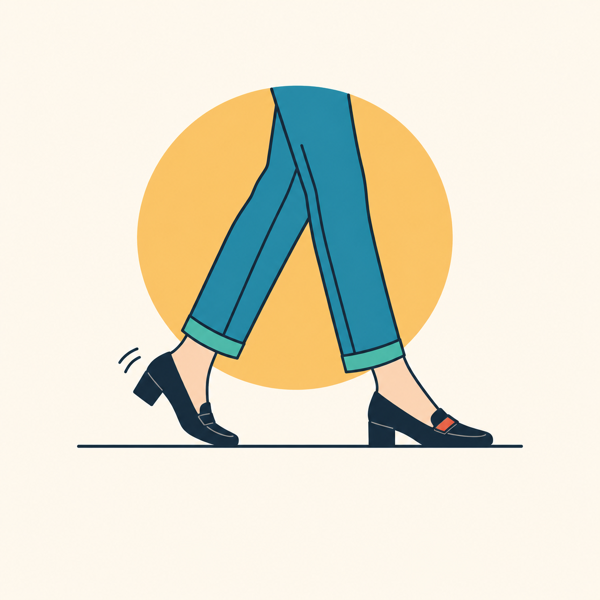
2 minutes of brisk walking: down the corridor, round the building, or three times round the table. Take a colleague.

Tip: Walk briskly, so that you can just about still talk.

What it does

Short walks between spells of sitting keep your blood sugar flatter after eating, and clear your head. Dunstan et al. 2012

Say to a colleague: “I've got two minutes, so I'm doing a lap of the building. Coming? Whoever comes back with the best idea wins.”

The walking meeting

The walking meeting

A conversation between two people works on foot too. Ideas come more easily when you walk, and that has been measured.

Tip: Perfect for brainstorming and fresh angles. For decisions involving numbers, you're better off sitting down.

What it does

On the move, people came up with well over 50% more creative ideas than sitting down. Oppezzo & Schwartz 2014

Say to a colleague: “That meeting of ours: shall we walk and talk instead? Ideas come more easily on the move. And if we don't decide anything, at least we'll have taken a few steps.”

Oppezzo & Schwartz, Stanford 2014
On one leg

On one leg

By the kettle, while you wait: 10 seconds on your left leg, 10 on your right. Whoever lasts longest gets the first cup.

Tip: Fix your eyes on one point, keep your knee slightly bent and stay near something sturdy.

What it does

Being able to stand on one leg is a sign of a fit body, and balance stays trainable, right there by the kettle. Araujo et al. 2022

Say to a colleague: “On one leg until the kettle boils: ten seconds left, ten seconds right. Wobbling's allowed, falling over isn't. First foot down pours.”

Print the tracker for your desk: a ✓ every 30 minutes, the GOOD. lunch break and four ways to challenge your colleagues. Download the tracker (PDF) →

Do you have any symptoms, an injury or high blood pressure? Check with your own doctor or physio which exercises suit you.

Free download

The parking sheet

Before you head out, take 30 seconds to jot down where you've got to and what comes next. Your mind doesn't have to hold on to the task while you walk, and after lunch you pick it straight back up.

In a study by Leroy and Glomb (2018), people who parked their task like this performed better on the task that followed. Their attention stayed less stuck on unfinished business. Leroy & Glomb 2018, Organization Science

The parking sheet has three parking bays, each with a number plate for your project or task. Fill it in on screen or on paper.

Download the parking sheet (PDF)

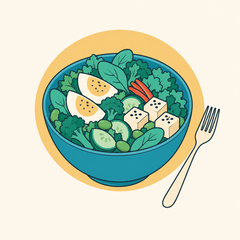
The GOOD. lunch break

A lunch break is more than eating. Here's what happens when you use it well, and how strong the evidence is for each step.

What you doWhat happens in your body and mindWhat you notice at 4pm
Away from your deskLaptop shut, off the grid for a bit
Your mind switches off from workWhen you choose to switch off; being told to doesn't help
Less tired at the end of the day
Mindful eatingVeg first, then protein, carbs last
Fullness hormones do their jobYou notice sooner that you've had enough
You stay full for longer
MoveA fifteen-minute walk after eating
Your blood sugar rises less sharplyYour muscles take up sugar as you walk
Less of a slump and fewer cravings at 4pm
Get outsideDaylight, greenery, fresh air
Nature and daylight restore your attentionLess overthinking
Better focus in the afternoonEspecially if you enjoy the walk
strong evidence moderate evidence weak evidence

Sources: Trougakos et al. 2014; Wendsche & Lohmann-Haislah 2017; Sianoja et al. 2018; Bratman et al. 2015; Stevenson et al. 2018; Dunstan et al. 2012; Buffey et al. 2022; Shukla et al. 2015 and 2017; Wyatt et al. 2021.

A lunch that saves your afternoon

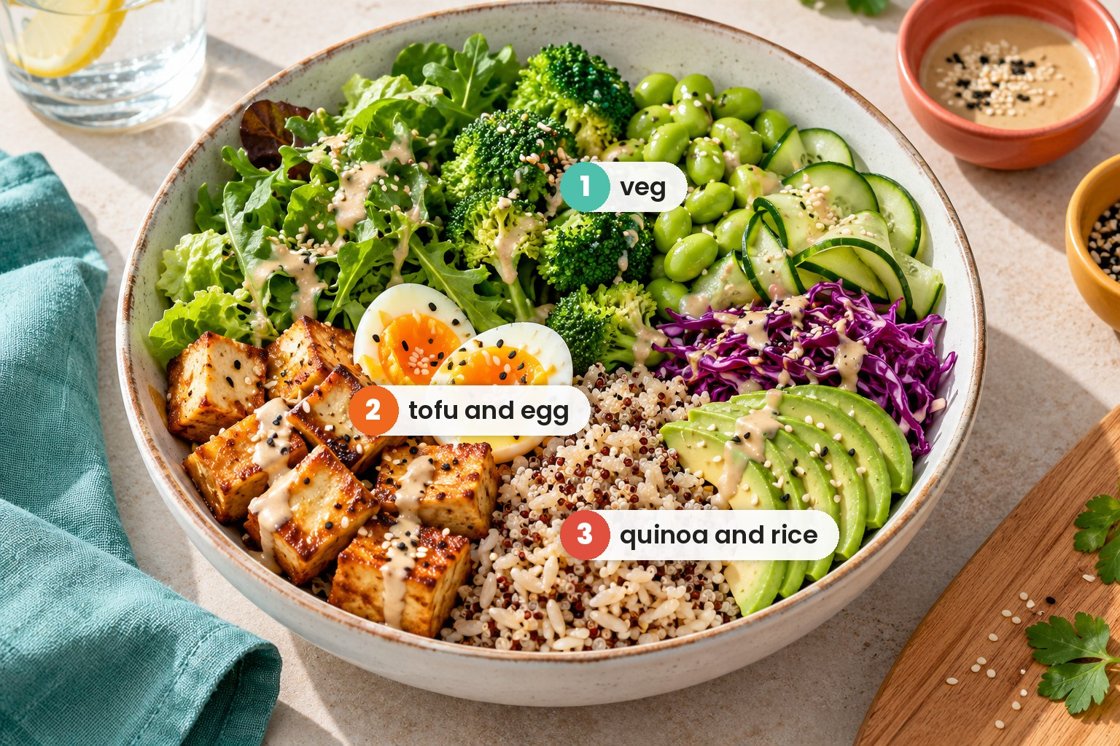
What you eat at lunchtime, you feel at three o'clock. Start with bread or pasta and your blood sugar shoots up, then drops an hour later: the infamous afternoon slump, with a craving for something sweet close behind.

Start with veg and the fibre forms a kind of mesh in your gut first. The sugar from your carbs then reaches your blood more slowly, and your energy stays steadier. You don't have to cut anything out. You just change the order.

  1. 1Veg first
  2. 2Then protein and fat
  3. 3Carbs last
A GOOD. Bowl with numbers: 1 veg, 2 tofu and egg, 3 quinoa and rice

Five ways, for every working day

The GOOD. Bowl

for keen batch cooks

Build your bowl at home, layer by layer. Carbs at the bottom, protein above that, plenty of veg and a dressing on top. Lid on, and at work you eat from the top down: the right order without even thinking about it.

The recipe
  • At the bottom: 100 to 150 g cooked quinoa, brown rice or potato.
  • Then: 150 to 180 g chicken, fish or tofu, or 3 eggs with a good spoonful of quark or Greek yoghurt.
  • On top, generously: salad leaves and raw veg, plus steamed veg (broccoli, green beans, edamame).
  • To finish: 2 tbsp sesame tahini dressing: 3 tbsp tahini, 2 tbsp tamari, 1 tbsp sesame oil and the juice of 1 lemon, thinned with warm water a spoonful at a time.

The staff canteen

for grab-what's-there types

Start with a bowl of soup or something from the salad bar, and finish it first. Then your protein: a boiled egg, chicken, fish or hummus. The sandwich or hot dish comes last. White or wholemeal? Go wholemeal.

The packed lunch

for loyal lunchbox fans

Add a tub of crudités: cucumber, carrot sticks or cherry tomatoes, and eat those first. Fill your sandwich with something that keeps you going, like egg, chicken, salmon, hummus or cottage cheese. Save the jam for the weekend.

Last night's leftovers

for smart cooks

Cook an extra portion in the evening. Potatoes, rice or pasta that have spent a night in the fridge partly turn into resistant starch. It behaves like fibre, even when you warm it up again. Veg first, then the rest.

The business lunch

for when you're eating out

Order a salad or soup to start, or begin with the veg on your plate. Leave the bread basket alone until your veg is gone. Nobody will notice, and you won't be yawning through the 3pm presentation.

And afterwards? Fifteen minutes outside. That completes the GOOD. lunch break.
Tanja Thielen

With your whole team?

Send this page to your team. Moving together is easier, and every exercise comes with a line to get your colleagues on board.

Tanja Thielen, health strategist

Every Sunday: The 5 GOOD. minutes

The 5 GOOD. minutes is my newsletter: every Sunday, one habit you can use on Monday, and why it works. A five-minute read, shorter than the adverts before your favourite series. Sometimes a recipe, sometimes an exercise, and now and then a sabre-toothed tiger explaining why stress feels the way it does.

© 2026 Tanja Thielen, GOOD.