Three times in one week, someone asked me about Ozempic. A client wondering whether to start. Someone five months in who wanted to stop but didn’t dare. And a friend who messaged me at half ten at night: “what do you actually make of it?”
The switch those injections flip has been sitting in your own body all along. And more than one road leads to Rome.
What the injection copies is one single thing: GLP-1, the satiety signal your gut makes for itself every single day. Which means the factory is already sitting in your belly.
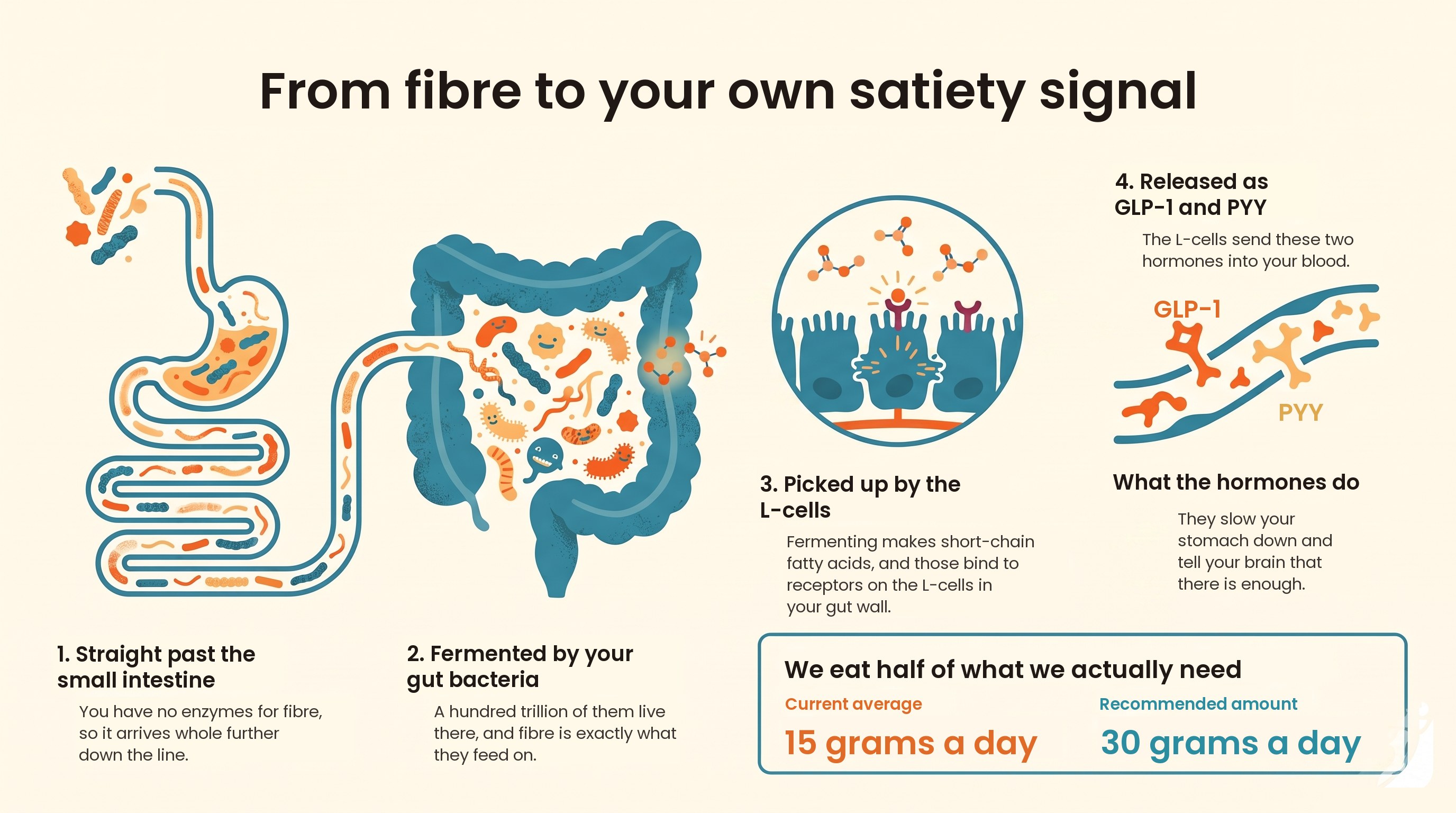
From your plate to your gut bacteria, to short-chain fatty acids, to your own GLP-1 and PYY.
What strikes me is that it’s almost never pure enthusiasm. People would love the effect and they’re wary of it at the same time. It’s expensive, and you pay for it yourself. You have to inject it. There are side effects. And nobody tells you up front what happens when you stop.
I love talking about strength and energy, but most people who write to me about this, men as much as women, just want to lose weight. You’re allowed to say that out loud. You want it to stay off, and you’d rather your face didn’t look ten years older once the weight has gone.
If you’re on Ozempic, Wegovy or Mounjaro, or thinking about it, you’ll get no judgement from me. For some people these medicines are a genuine relief. I’m not a doctor, I’m not giving medical advice here, and I’m not going to tell you to come off anything. That conversation belongs with you and your GP.
In short
- These medicines mimic GLP-1, a satiety signal your gut already makes every single day.
- Around 40% of the weight lost is fat-free mass. How much muscle you keep comes down to protein and strength training.
- Stop, and much of the weight returns. Which is exactly why it pays to build something of your own alongside it.
- You can flip those switches yourself, at a pace your body can keep up with. There are five of them, and you start today.
What these medicines copy
Every time you eat, your gut sends these little messages, and they tell your brain you’re sorted. Your stomach empties more slowly, your appetite drops, your blood sugar holds steadier.
The medicine turns that one signal up hard from the outside, and keeps it there. But the switch itself isn’t new. It’s been in your body all along, working every day, just more in harmony with your body than the pharmaceutical version.
That these medicines work is settled. It’s just that nobody ever taught you to work that switch yourself.
What the research honestly shows
Not to frighten you. To give you the whole picture, because I can’t stand half a story.
Some of what you lose isn’t fat. In the big semaglutide trial, roughly 40% of the weight people lost was fat-free mass (Wilding et al., New England Journal of Medicine, 2021). I have to add nuance straight away, because the headlines overshoot here: fat-free mass isn’t the same as muscle. It also covers water, glycogen, connective tissue and organ mass, and you see that proportion with almost any substantial weight loss. What you should take from it is this: how much muscle you keep depends far more on your protein intake and your strength training than on the medicine. Past forty, that counts double.
Then there’s what happens when you stop. The follow-up studies show a large part of the weight comes back, and the improved markers drift towards where they started (Wilding et al., Diabetes, Obesity and Metabolism, 2022). That isn’t people failing. It points at something more basic: as long as a signal from outside does the work, your own system never learns to.
And in practice, a large group stops within one or two years. For all sorts of reasons: the cost, the side effects, a pharmacy that can’t supply. Which makes “what am I building in the meantime” a fair question for nearly everyone.
The face everyone’s talking about
Online it’s called Ozempic face: hollow cheeks, sharper cheekbones, skin that suddenly sits looser. Slimmer, and a few years older at the same time.

One woman, three moments. Same weight gone each time. In the middle it came off in a hurry; on the right her skin was given time to keep up.
I looked it up, because I wanted to know whether it holds. It does, though not in the way it’s usually told. This isn’t some mysterious effect of the drug. Your face has small fat pads that give it its fullness, and they shrink along with everything else when you lose weight. If that happens fast, your skin doesn’t get the time to keep up. You see exactly the same thing after bariatric surgery or a strict diet. With these medicines it simply tends to go quicker, and past forty your skin has less in reserve to absorb it.What you do about it isn’t exciting, and it’s the same as what you’re already doing for the rest of you: lose weight more slowly, eat enough protein and keep loading your muscles. Those three are exactly what the five days below walk you through, one a day, with the plan handed to you as you go.
Free
The free five-day training
Five days, one switch a day to put your own GLP-1 to work, with the full day, week and month plan as a PDF each time. Pop your email in and you start today.
Free. No spam, unsubscribe whenever you like.More than one road to Rome
Some of you are weighing up whether to start medical weight loss: losing weight on medication, under a doctor’s supervision. Others are in the middle of it and can feel this isn’t forever.
The answer is the same for both, and it’s good news. There’s more than one way to Rome. Take a different road and you learn to work those same switches yourself. Already taking it and thinking about tapering with your doctor? Then a solid base is exactly what lets you land softly and bring your muscle with you.
That base has five pillars for me. Together they spell GOOD.
G is for glucose aware

Your blood sugar directs your energy, your mood, your focus and your appetite. Start your meal with fibre and vegetables, then protein and fat, and leave the fast carbs until last. Your spike flattens. Flatter spike, steadier afternoon, less of that rollercoaster where you’re hungry again two hours later.
That three o’clock energy dip and the craving for something sweet aren’t a character flaw. That’s glucose bouncing. This step costs nothing and it’s on your plate tomorrow. I went into it properly in Eat in this order and your blood sugar spike halves.
One more thing that helps: ten minutes of walking after you eat. Your muscles pull glucose straight out of your blood, no extra insulin needed. Ten minutes. That’s shorter than the episode you’ll watch afterwards.
O is for optimal movement

Your muscles need attention, especially while you’re losing weight. Strength training, at least twice a week and across all your big muscle groups, keeps you solid as the scales move. It’s the best-supported step there is, and it’s also the only one no medicine does for you.
Then there’s movement in the small moments. Squats while you brush your teeth, a stretch while the coffee brews, stairs instead of the lift. And get up every half hour, because half an hour of sitting is enough for your metabolism to wind down.
Keep telling your muscles you still need them. Otherwise they’ll believe you.
O is for optimal natural support
Your gut bacteria turn fibre into short-chain fatty acids, and those trigger the very satiety signals these medicines copy (Chambers et al., Gut, 2015). The catch is that the average European eats about half the fibre they need, so the factory runs at half power.
That makes fibre the most underrated step going. Vegetables, pulses, oats, flaxseed, and when that doesn’t happen, a good fibre once a day. I use dōTERRA Fibre myself.
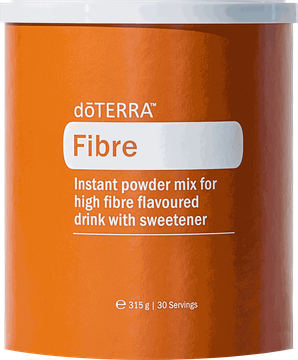
dōTERRA Fibre
6.5 g of fibre per scoop, both soluble and insoluble, with prebiotics thrown in. It dissolves completely and tastes fresh and lemony, so you actually take it every day.
Read about Fibre →There is a second road to that same satiety signal, and the research on it caught me off guard. In doTERRA’s own study, which hasn’t been peer-reviewed, GLP-1 in the blood was up within a quarter of an hour of taking MetaPWR Advantage, and it stayed up for well over an hour after that. It comes down to the collagen tripeptides: chains of three amino acids, short enough to cross your gut wall intact. The same study found more of your own NAD+ after six weeks, the coenzyme that fuels your energy metabolism and tails off as the years go by. Which is why I take it right before my biggest meal.
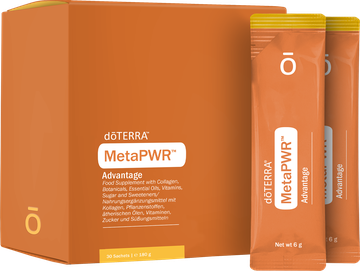
MetaPWR Advantage
Collagen tripeptides as building material for your skin and connective tissue, plus a yeast complex that supports your own NAD+ production.
Read about Advantage →Next, protein. There’s a principle called protein leverage: eat too little protein and your appetite keeps nagging until you’ve had it, even when you’ve had plenty of calories (Simpson and Raubenheimer, Obesity Reviews, 2005). Give your body what it’s actually asking for and you spend far less energy fighting your own hunger. A decent protein at breakfast is the simplest change most people can make.
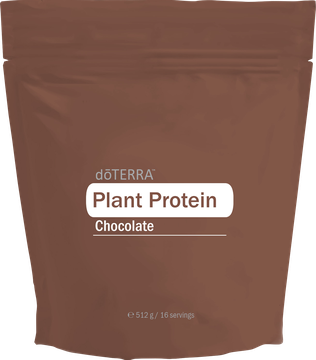
doTERRA Plant Protein
Four plant sources combined, which gives you a complete amino acid profile. 24 g of protein a shake in vanilla, 22 in chocolate, with no dairy, soy or gluten.
Read about Plant Protein →Underneath all that sits the foundation: micronutrients and omega-3. Not thrilling, but it’s the difference between a body that wants to cooperate and one with the brakes on. What else lives in my cupboard, and why, is in Supplement jungle: from FOMO to JOMO.
D is for deep emotional balance
Not every craving comes from your stomach. A good share comes from stress, from boredom, from a day that was too full. Whatever quietens physical hunger doesn’t touch that other hunger, and that’s usually where things unravel.
There’s a physical side too. Live in stress mode long enough and cortisol pushes fat towards your middle and winds up your appetite for sugar. You can eat and train beautifully, but if your system never leaves alert mode, you’re working against yourself.
What helps is rarely dramatic. Breathing before you eat. A walk without your phone. A blend I roll on my wrist, bring to my nose and breathe in three times, slowly. For me that’s the signal that the day is allowed to come down now. I use Adaptiv for that, and why that one in particular I’ve written about before.
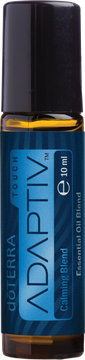
Adaptiv Touch
The calming blend as a roller. On your wrist, up to your nose, three slow breaths in. For me that's the signal that the day is allowed to settle.
Read about Adaptiv Touch →Sleep belongs here as well. A bad night changes your appetite the very next day: more ghrelin, less leptin, more cravings for exactly the things you’ll regret by morning (Spiegel et al., Annals of Internal Medicine, 2004). So don’t leave sleep until everything else is sorted. Start there.
The full stop after GOOD.
That full stop isn’t punctuation, it’s your turning point.
A medicine can change your weight. It can’t change the person you’re becoming, and it won’t hand you new habits. You build those yourself, day after day, with choices that stack until one morning you notice you’re no longer thinking about the order on your plate. That’s the moment it’s yours. I wrote about it in This is your turning point.
In menopause, all of this counts double

Most people who write to me about this are women between 40 and 60. That’s no accident, and it isn’t because that group has less discipline.
Around menopause, fat moves from hips and thighs towards the middle, and insulin sensitivity drops. Some of that happens independently of ageing and tracks the hormonal shift itself (Greendale et al., JCI Insight, 2019). On top of that, oestrogen normally dampens your stress axis. Take it away and your body reacts to stress with the brakes off. And hot flushes and night sweats break your sleep, which sends your appetite everywhere the next day.
This is chemistry, and chemistry doesn’t listen to good intentions.
Here’s what I’ll say out loud, even though few people in my field do:
What I'll say out loud
Talk to your GP about hormone replacement therapy
For a lot of women within roughly 10 years of menopause it's a legitimate and effective option, and the fear that took hold after 2002 has since been considerably qualified. I don't sell hormones and I've nothing to gain from it. I just think you're allowed to ask the question without feeling awkward about it.
And the rest? Those five pillars don’t work differently during menopause, they simply weigh more. Strength for your muscles and your insulin sensitivity, protein, fibre, protecting your sleep, taking your stress seriously. Essential oils belong in this list as ritual and as comfort, for calm and for the night. Not as hormone replacement, because they aren’t that and I’m not going to claim they are.
Where you start tomorrow
Whether you never want to start a medicine or you’re right in the middle of one, the road is the same and you can take it today. The free five-day training walks you through it one step at a time, and if you would rather have everything in the house at once, the two starter bundles sit side by side.
Put your plate in the right order. Train your big muscle groups twice a week. Feed your own satiety signals with fibre and protein. Protect your sleep. And get your system out of alert mode, because there’s very little you can build in survival mode.
On one of these medicines and thinking about coming off? Always do that with your doctor. And build this base in the meantime, so there’s something to land on.