Lunchtime in this house comes with one fixed ritual: Enzo gets his walk, every single day, because dogs don’t do days off. For years I treated that walk as maintenance: good for my head, good for my blood sugar after a meal. Then I read what Japanese researchers have been measuring for almost twenty years. They change just one thing about a walk like ours, the pace, and it becomes a workout. My first thought was: “Walking is lovely, but it isn’t exercise.” The numbers below won me over, and these days Enzo and I walk the Japanese way, fully converted.
How it works
The system is surprisingly simple: 3 minutes of brisk walking, then 3 minutes at an easy pace, and that alternation 5 times in a row. That adds up to 30 minutes, and in the studies people did this on 4 or more days a week.

Brisk does not mean running, and it does not mean panting either. It is the pace at which talking still just works, but only in short sentences. You get warm, your arms start swinging along by themselves. If you want precision, a heart rate monitor helps: subtract your age from 220 and take 70% of that. For someone of 55 that is roughly 115 beats per minute. The easy minutes are simply your normal pace, where your breath settles and conversation flows again.
What the first study showed
The method comes from the team of Professor Hiroshi Nose at Shinshu University, and the first major results appeared in Mayo Clinic Proceedings in 2007. The researchers followed 246 people with an average age of 63, for 5 months. One group got the classic advice: keep walking at a steady, moderate pace, at least 8,000 steps a day, at least 4 days a week. The other group did the intervals.
The differences were not subtle. In the interval group, knee extensor strength rose by 13% and knee flexor strength by 17%, and fitness (how much oxygen your body can use at its peak, the best measure of fitness we have) improved by 8 to 9%. Resting blood pressure also dropped clearly more than in the steady walkers. The group dutifully collecting their 8,000 daily steps barely moved on any of those measures.
The difference lies in the training stimulus. At comfort pace, your heart and muscles get no reason to grow stronger; what you are asking, they can already deliver. Those 3 brisk minutes briefly ask more than your body is used to, and that shortfall is what sets the adaptation going: muscle fibres strengthen and your heart pumps more blood per beat. That short spell above your comfort zone is what separates a stroll from a workout.
And look again at where the gains sat: in your thighs, the largest muscle group you have. From about 50 onwards you slowly lose muscle mass unless you put something against it, and leg strength is precisely what decides, later in life, whether you stay independent: climbing stairs, getting up from a chair. A form of walking that demonstrably strengthens the knee extensors and flexors hits the very spot where ageing strikes first.
How much that leg strength matters is clear from American research that followed 2,292 people aged 70 to 79 for around 5 years: the stronger the knee extensors, the smaller the chance of dying within those years. A striking detail: it was about strength, not size. Muscle mass on its own predicted little. What your thigh muscles can do is one of the better gauges of how long you stay healthy, and that is exactly what this way of walking trains.
The 50-minute rule
The Shinshu team kept measuring, and in 2019 published an analysis of 679 participants with an average age of 65. After 5 months of interval walking, fitness was 14% better on average and the score for lifestyle-related conditions (a combined measure including blood pressure, blood sugar and cholesterol) was 17% lower.
The researchers also worked out which dial drives the effect, and the answer was unambiguous: the number of brisk minutes per week. The gains grew up to about 50 brisk minutes a week and levelled off beyond that. The easy minutes and the total walking time made no difference to the measurable effect. Don’t get me wrong: those easy minutes are not wasted time, they are what makes the whole thing sustainable. But it does mean that 4 walks with 12 to 15 brisk minutes each bring in the full reward. An hour of ambling a day is good for your head, but it is not training.
Your blood sugar and belly fat respond too
Then researchers from Copenhagen picked up the protocol, with a study that fits the GOOD. pillars seamlessly. They had people with type 2 diabetes walk for an hour, 5 times a week, for 4 months: one group continuously at a moderate pace, the other in blocks of 3 easy and 3 brisk minutes. Both groups burned the same energy; only the rhythm differed.
The result: the interval group improved fitness by 16%, lost fat mass including deep belly fat, and saw both average and peak blood sugar values come down (measured continuously with a glucose sensor). The steady walkers, burning exactly the same energy, changed on none of those points.
That ties in with what I wrote about belly fat last week, with one honest nuance added. The deep fat around your organs is busy tissue that moves with your lifestyle, but not equally fast in everyone: in men it responds first, while women in menopause face hormonal headwind, because the body is then actively moving fat to the belly to keep producing oestrogen. That headwind does not mean movement is pointless for you; it only means you see the result on your belly more slowly than a man would. Because the mechanism this study rests on belongs to everyone: muscles at work take up glucose from your blood without insulin needing to get involved, and brisk minutes hand your muscles that work. To be clear: this was a study in people with type 2 diabetes, and research in one group does not simply transfer to everyone. But for women in menopause it is no reason to give up, rather one to take the brisk blocks seriously.
My own experience
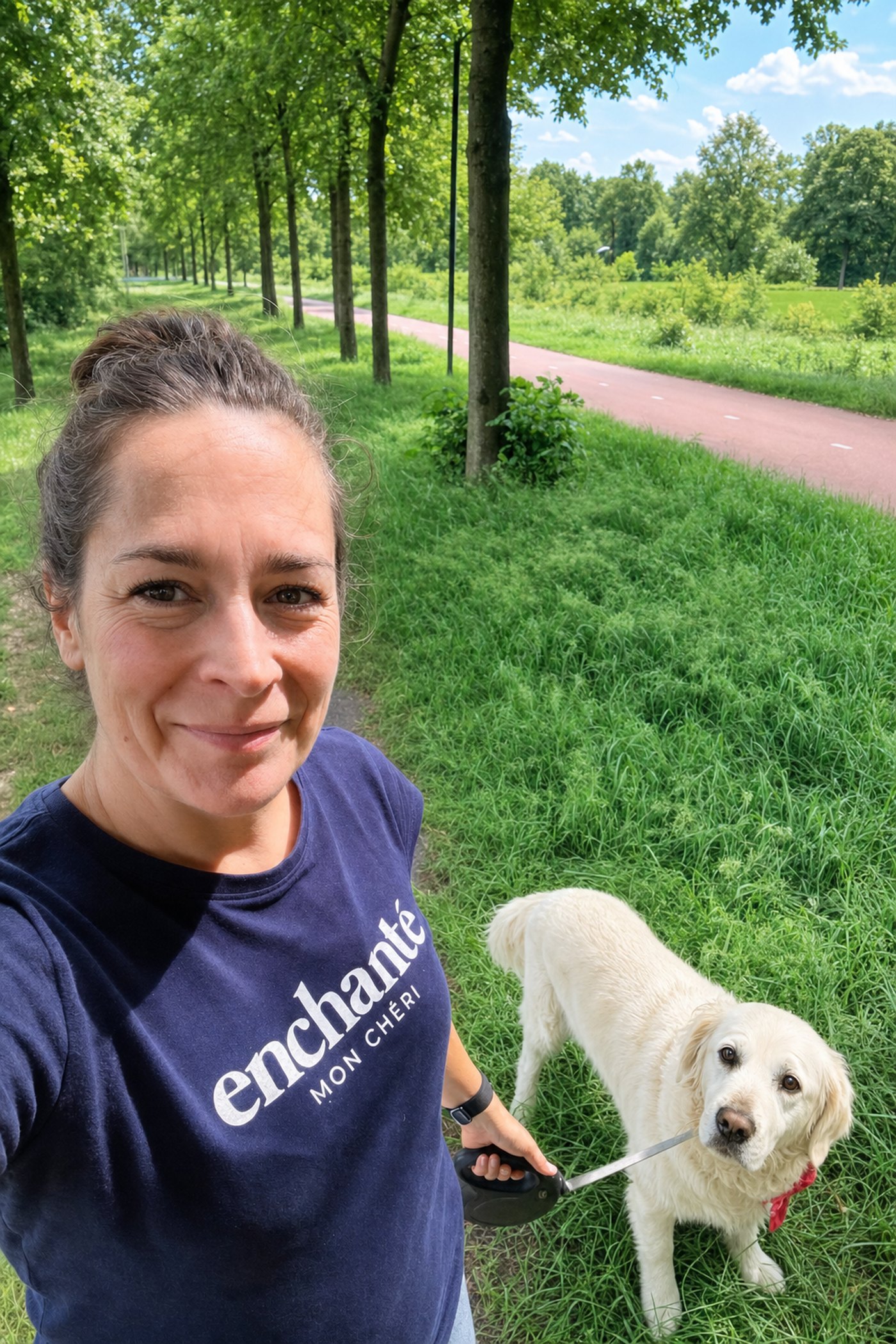
The brisk blocks are now a fixed part of our lunchtime walk, and on busy days they shift to the evening one. What surprised me most: afterwards I can tell I’ve had a workout, yet I’m not wrecked. Pleasantly tired, and sharp again by mid-afternoon. And there is one advantage no study mentions: Enzo can keep up. Running is no longer on the cards at his age, but he loves this rhythm, and he stops all the time anyway. Every time he needs a thorough sniff somewhere, my easy block begins; he polices my training schedule better than any app.
And since this is Japanese walking after all, I have made a small ritual of it. Before we set off I roll Shinrin-Yoku on my wrists: the blend inspired by Japanese forest bathing, woody and fresh, a forest walk for your jacket pocket. And afterwards my knees and calves get the Deep Blue Stick, wonderfully cooling after the brisk blocks.
Start today

Take your next walk and drop in 2 brisk blocks of 3 minutes; walk the rest as usual. A timer on your phone works, but so do landmarks: brisk to the third lamppost, easy to the bridge. Build up to the full 5 blocks over a few weeks, and remember the dial that matters: around 50 brisk minutes a week, spread over 4 walks.
A smart moment is the walk after a meal, when your muscles help take up the glucose from your food. And reach for your tape measure now and then; how to measure is here. Your waist responds to this kind of movement sooner than your scale does.
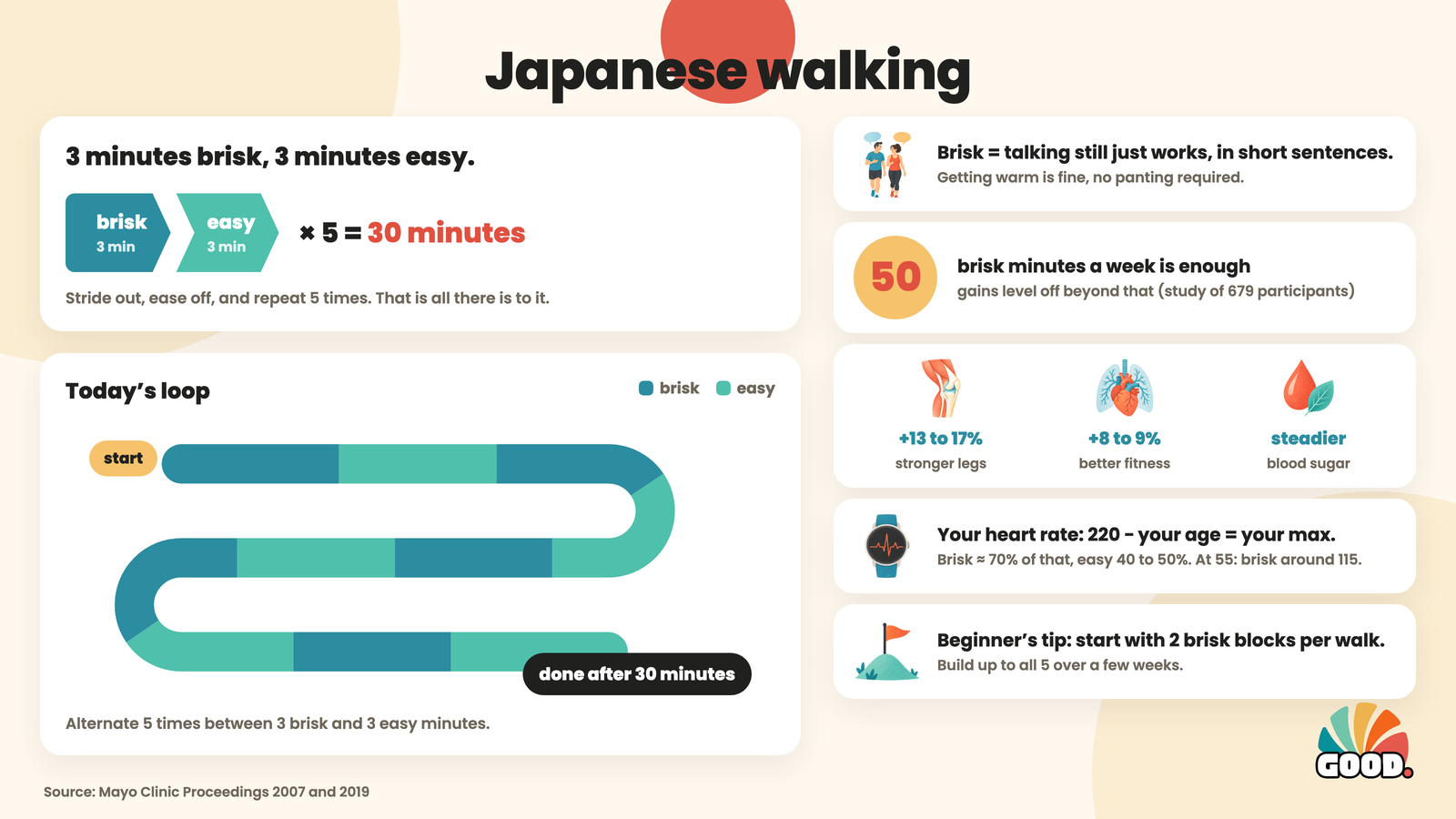
Want it all in one place? Download the Japanese walking card (PDF): the method, your heart rate range by age, and how to measure. And for the walk itself there is 30 minutes of walking music: the music does the work for you: when the rhythm swells, you stride out; when it turns still and dreamy, you ease off. No talking, no beeps, just music.
Do you have heart problems, blood pressure under treatment, or doubts? Have a quick word with your GP before you turn up the pace.