

Why that “innocent” cup of coffee sabotages your energy, messes with your hormones, and slowly breaks you down
I know you don’t want to hear this. That coffee you grab every morning like a lifeline? That warm comfort that carries you through your day? That social glue of all your meetings?
It’s a drug. And you’re addicted.
“But Tanja, everyone drinks coffee! It can’t be that bad?” Oh sweet summer child, everyone used to smoke too. Everyone thought fat made you fat. Everyone believed the earth was flat. Popularity is not proof of truth. Let me open your eyes to what coffee REALLY does to you. Spoiler alert: it’s not pretty and you can’t unknow this after reading it.
The hard science: why coffee is your enemy
1. The Adenosine hijack: your natural energy system gets kidnapped
Adenosine is your body’s natural “tiredness detector.” It builds up in your brain during the day and when there’s enough, you get the signal: time to rest. Pure biology, perfect system.
Caffeine? It blocks your adenosine receptors. It’s like taping over the smoke detector in your house – you can’t smell the smoke anymore, but the house is still on fire.
Your body thinks: “Hmm, I’m not getting tiredness signals anymore. I must make more adenosine receptors!” And it does. More and more. Result? Tolerance. You need more and more coffee for the same effect.
And when that caffeine wears off? All that accumulated adenosine floods your system like a tsunami. Hello crash. 🥱 Goodbye energy. Hi sugar cravings. 🐷
The research: Studies show that chronic caffeine users have 40% more adenosine receptors than non-users. You have literally reprogrammed your brain to be dependent on an external drug.
2. Cortisol chaos: your stress hormone goes through the roof
Remember my earlier research on cortisol and weight gain? Well, your daily coffee is a major cortisol trigger.
The scientific facts:
- Caffeine raises cortisol levels by 30-50% within 30 minutes
- This effect lasts 6-8 hours (yes, that morning coffee is still sabotaging your system when you have lunch)
- In stressed people this effect gets even worse – cortisol goes through the roof
- Chronically elevated cortisol = belly fat, sleep problems, diabetes risk
The vicious cycle: Stress → coffee for energy → more stress from elevated cortisol → more coffee needed → even more stress. See the pattern?
3. Sleep sabotage: why you’re lying awake at night
Caffeine has a half-life of 5-6 hours. That means:
- Coffee at 08:00? Still 50% active at 14:00
- Coffee at 15:00? Still 50% active at 21:00
- And at 3am? That afternoon coffee is still 25% in your system
The research is crystal clear: Caffeine reduces your deep sleep phases by 25-40%. You might be sleeping, but you’re not recovering. You wake up like a zombie and reach for… coffee. 😝
The result according to science:
- Less than 6 hours sleep = 40% worse insulin sensitivity the next day
- Sleep deprivation increases ghrelin (hunger hormone) and decreases leptin (satiety hormone)
- Risk of type 2 diabetes rises by 30% with chronic sleep deprivation
Coffee → poor sleep → hormone chaos → diabetes risk. The circle is complete.

4. The mineral robbery: coffee steals your health
Here’s where it gets truly criminal. Coffee is a top-tier mineral thief:
Calcium sabotage: Coffee reduces calcium absorption. Every cup of coffee = calcium loss. Drink 3 cups a day? Then you lose enough calcium annually for a noticeable decline in bone density.
Iron blockade: Coffee inhibits iron absorption if drunk within 1 hour of a meal. Tired? Maybe not because you’re low on coffee, but because you’re low on iron.
Magnesium exodus: Coffee stimulates magnesium loss through the kidneys. Magnesium deficiency = muscle cramps, headaches, insomnia, anxiety, heart palpitations. Sound familiar?
Zinc and other trace elements: Coffee can disrupt the absorption of various minerals, potentially creating deficiencies that can affect your immune system, hormonal balance, and wound healing.
B-vitamin blocking: Especially B1 (thiamine) is poorly absorbed. B1 is essential for energy metabolism. Ironic, isn’t it? You drink coffee for energy, but it blocks the vitamins that give you real energy.
5. Neurotransmitter chaos: your brain gets hijacked
Coffee disrupts your entire brain chemistry:
Noradrenaline overdose: Coffee causes chronically elevated noradrenaline. That’s your fight-or-flight hormone. You’re in survival mode all day. Rest? What rest? Your body constantly thinks there’s danger, causing your stress responses to run on overdrive. Even small frustrations suddenly feel like existential crises.
Dopamine desensitising: Your brain becomes less sensitive to dopamine (your reward hormone). Result? Less pleasure from normal things. You need more and more stimulation to feel good. That beautiful sunset you used to appreciate? Meh. That fun film? Boring. Your brain screams for more, more, more – and coffee seems like the temporary solution.
GABA suppression: GABA is your natural chill pill. Coffee suppresses it. No wonder you can’t relax in the evening. Your body literally has less of the ‘braking neurotransmitter’ that should keep you calm. It’s like your car only has an accelerator, no brakes.
Serotonin chaos: Disruption of your happiness hormone. Hello mood swings, irritability, and that famous “grumpy mode” before your first coffee. Your baseline happiness drops, making you dependent on external triggers for feeling good. Without coffee you’re literally a less happy version of yourself.
Plot twist: why “decaf” is also nonsense
Decaf still contains caffeine: Up to 7mg per cup. Sounds little, but for sensitive people or multiple cups a day it adds up. For context: sensitive people notice effects from as little as 12-25mg of caffeine. Drink 3 cups of decaf? You’re already at the level of a weak green tea.
Chemical processing nightmare: Most decaf is made with methylene chloride or ethyl acetate. Carcinogenic substances your liver has to detox. You’re replacing one toxin with another. There are “water-processed” decaf varieties, but they’re more expensive and much harder to find. Plus, this still doesn’t solve the other problems.
Acidity problem: Coffee is acidic (pH 4.5-5). This disrupts your digestive system, stimulates cortisol production via stress on your adrenals, and can cause gastritis. Decaf is often even more acidic than regular coffee due to the processing. Recognise that burning feeling, burping or stomach pain after coffee? That’s your stomach screaming for help – the acidity irritates your stomach lining and can lead to inflammation.
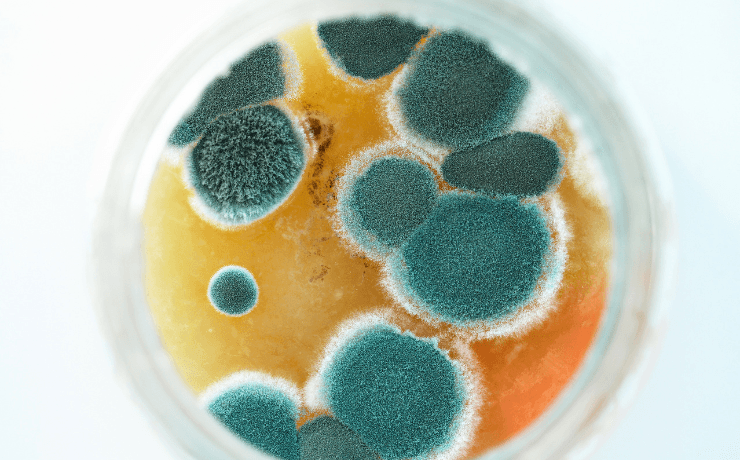
Mycotoxins: And here it gets truly unpleasant – this problem applies to ALL coffee, including those expensive specialty blends. Fungal toxins develop during the drying and storage of coffee beans, especially in tropical climates where humidity is high. Studies show that 91.7% of green coffee beans and 100% of commercial instant coffee contain mycotoxins. These toxins (especially ochratoxin A and aflatoxins) burden your liver, can trigger inflammatory responses, and are linked to kidney damage.
My own coffee detox journey (it wasn’t easy)
Let me be honest: I was addicted too. Hardcore. 4-5 cups a day, since I was 16. I thought I would literally die without coffee. ☕️💀
Phase 1: Denial (months 1-6) 🙈 “I only drink organic coffee, that’s different.” “I don’t have a problem, I function fine.” “Everyone drinks coffee, so it can’t be bad.”
Classic addict behaviour. Check. ✅
Phase 2: Half measures (months 6-12) 😅 Switched to “caffeine-free” coffee. Felt superior. Until I did the research on that chemical processing and residual toxins. Shit. 💩
Phase 3: Black tea transition (months 12-18) 🍃 Tea has less caffeine (25-50mg vs 100-200mg in coffee). With milk it still felt “normal.” But still caffeine, still dependence, still cortisol spikes. 📈
Phase 4: Cold turkey (month 18-19) 😵💫 Holy shit. The first week was hell. Headache that felt like my skull would explode. 🤯 Fatigue like having the flu. Mood swings that made my family question my sanity. 😤
But then… magic. ✨
Week 3-4: The breakthrough 🌅 Suddenly I woke up and was… awake. Without an external drug. My natural circadian rhythm came back. That 3pm crash? Gone. Poof! 💫
Month 2-3: The new normal 🦋 Stable energy all day. Deep sleep (finally!). 😴 Fewer stress reactions. My mood was stable – no more of that Jekyll-and-Hyde stuff. 😇
Now, 2 years later: 🏆 One cup of black tea in the morning, max. And I’m even considering dropping that. Because I notice the difference on days I don’t drink it: even more stable, even calmer. 🧘♀️
My current energy protocol
Instead of coffee as a fake energy booster, here’s what I do:
Morning ritual (07:00-09:00) 🌄
My day starts with a MetaPWR Advantage shot – pure plant power without the crash, just clean focus. With that I take 2 capsules Mito2Max that support my mitochondria (cellular energy factories) naturally, and 2 MetaPWR softgels for healthy fat burning. And yes, I still drink one cup of black tea (with 1/2 tea bag) – my last caffeine ritual that I’m working on! 🍵
When I do feel a dip 🔋
Instead of reaching for that second coffee, I take 2 more Mito2Max capsules during the day for sustainable energy without the crash. But usually I go for a 10-minute walk to activate my natural energy systems, jump 5 minutes on my trampoline (mine is in my living room), dance through my kitchen, or take a 30-second cold shower for instant alertness via a natural noradrenaline boost! 🚿❄️
The real energy game-changers are much simpler than you think:
Here’s the truth the coffee industry doesn’t want you to know. Real energy comes from balanced eating for stable blood sugar (no rollercoaster = no crashes), sufficient movement in the sun and nature where trees and plants produce volatile organic compounds that lower your stress hormones and boost your immune system. Sunlight not only triggers vitamin D production but also optimises your circadian rhythm via your pineal gland, regulating your natural melatonin production. The higher oxygen concentration in natural environments improves your cellular energy production, while natural sounds downregulate your stress response. Then there are activities with wonderful people who make you happy (joy is literally a natural energiser), and emotional balance because stress consumes energy while inner peace generates it. Plus of course those 7-9 hours of quality sleep that give you next-day superpowers. No drugs needed.

The coffee quit protocol that works
Because I know you’re now thinking: “Okay Tanja, I get it, but HOW do I stop without dying?”
Option 1: Cold Turkey (for rebels) 🔥
Stop today, completely. Expect hell for 7-10 days, then paradise. Your survival kit: lots of water because your body is now in detox mode and needs extra hydration to flush all those accumulated toxins through your kidneys and liver, doTERRA Zendocrine Complex for extra kidney support during the detox, doTERRA Bone Nutrient (magnesium supplement) for relaxed muscles (you can expect muscle discomfort during your coffee detox), Mito2Max for energy support at cellular level, peppermint oil or doTERRA PastTense on your temples and neck for natural relief from head tension (works better than painkillers and doesn’t damage your microbiome!), and warn colleagues, family, and friends that you’re temporarily going to be less fun to be around! 😂
Option 2: Gradual reduction (for normal mortals) 🐌
Weeks 1-2 halve your coffee intake, weeks 3-4 switch to black tea, weeks 5-6 halve your tea intake, weeks 7-8 just one cup of tea plus herbal tea, weeks 9-10 herbal tea only, and from week 11 you’re a free bird! 🕊️
Natural energy alternatives during your detox include doTERRA Mito2Max for cellular energy production, doTERRA MetaPWR Advantage for stable energy without crash, doTERRA MetaPWR Recharge for essential minerals your body needs during recovery, doTERRA Copaiba softgels for natural inflammation balance and stress support, doTERRA Serenity Restful Complex with tart cherry for better sleep quality, and also try green tea matcha for less caffeine but more L-theanine (calm alertness).
What to expect: the coffee detox timeline
The first 3 days are The Withdrawal Hell with headache, fatigue, irritability, and brain fog – your body is screaming for its drug, but stay strong! 💪 Days 4-7 the fog starts lifting, headache diminishes, and you get glimpses of your natural energy. Week 2 brings cautious optimism as your energy becomes more stable, sleep improves, and mood stabilises.
Week 3-4 is where the magic begins – holy shit, you wake up and you’re just awake without any extras needed, this is what normal feels like! 🤯 Month 2-3 you experience stable energy, deep sleep, balanced mood, and fewer stress reactions – you never want to go back. And after month 6 you look at coffee drinkers the way ex-smokers look at smokers: with compassion and understanding. 😌
“But Tanja, what if I still want to keep drinking coffee?”
Look, I’m not your mother. But if you absolutely want to keep drinking coffee, here’s your damage control: max 1 cup per day before 10am, always with food to buffer the impact, high-quality beans for fewer mycotoxins, supplement extra magnesium and vitamins, and no coffee 2 hours before and after meals because of iron absorption. Also take a week off every 3-4 weeks to reset your tolerance and give your adrenals a rest.
The inconvenient truth
Here’s what nobody tells you about coffee: it’s social conditioning. That whole “but I can’t do without coffee” culture is marketing, peer pressure, and collective addiction normalisation. It masks underlying problems – are you tired? Then fix your sleep, nutrition, and stress instead of masking symptoms with a drug. And it keeps you small because natural energy is always better than artificial energy. You deserve better than being dependent on an external substance.
Your move
You now have the facts, the science, the truth. You can keep rationalising this with “everyone does it,” “a little can’t hurt,” or “I need it for my work.” Or you accept the inconvenient truth and take action.
Option 1: Stay a slave to your coffee and accept the energy crashes, sleep problems, mineral deficiencies, and hormonal chaos as “normal.”
Option 2: Take back control, detox your system, discover your natural energy, and become the person you can be without chemical dependence.
So… what will it be? Your choice.

Start today (yes, today)
First track your current intake – how much coffee do you really drink? Be honest. Then choose your way out: cold turkey or gradual (I vote for cold turkey, but you know yourself best). Make sure you have all the support tools at home. Set a date and tell someone because accountability matters. Finally, plan for withdrawal hell by clearing your calendar as much as possible for the first week – this is not the time for big meetings.
For extra support during your transition the MetaPWR Advantage + Mito2Max combo helps for daily energy without crashes, a quality sleep routine of 7-9 hours (non-negotiable!), regular movement of at least 30 minutes per day, stress management through yoga or meditation, and more hydration than you think you need.
The bottom line
Your natural energy is powerful, pure, and all you need for a day full of vitality. Learn to enjoy the sunset and the flowers along the way again. Live with all your senses wide open. Life is beautiful!
Time to live it to the fullest. 🌟
Questions about your coffee detox journey? Send me a message. I’ve been there, and I’ll help you through it. More lifestyle tips? Take the GOOD. Assessment.
P.S. Yes, this post is going to trigger people. Good. Sometimes we need uncomfortable truths to create real change. Feel free to share this with that one colleague you always see at the coffee machine.