Cassia
The oil of the tree that most of the cinnamon in your spice rack comes from. Warm, sweet and spicy, and so strong that 1 drop flavours a whole recipe.
🔥 Cinnamomum cassia · warm and hotThese buttons take you straight to doTERRA to order. I earn a little from it, at no extra cost to you.
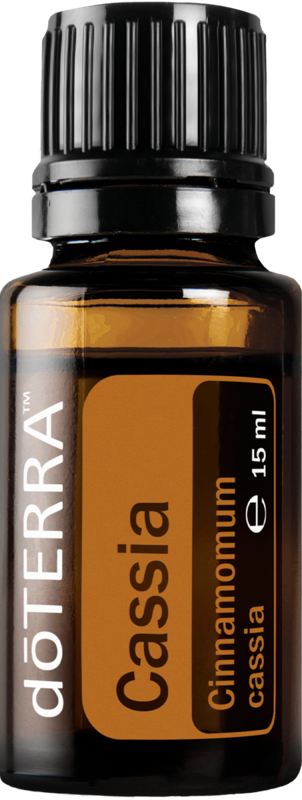
What Cassia is
Cassia comes from Cinnamomum cassia, an evergreen tree from southern China and a close relative of the cinnamon tree of Sri Lanka. You have probably had cassia in the house for years: most of the cinnamon sold in supermarkets is cassia. You can tell the two apart by the sticks. Cassia is a thick, hard, reddish-brown bark. Ceylon cinnamon is paler and made up of thin layers that crumble between your fingers.
The essential oil is that same flavour, concentrated. Most of the oil is cinnamaldehyde, the compound that gives cinnamon its smell and taste. Cinnamaldehyde also sets off a sensor in your skin and mucous membranes that responds to pungent compounds. It's the same sensor that lets you feel mustard and wasabi. That is why Cassia feels warm, and downright hot if you use too much.
In the kitchen that strength is handy. 1 drop stirred into the mix gives a whole recipe a full cinnamon flavour, as in my cinnamon truffles for Sinterklaas. The label lists Cassia for food flavouring, always diluted and with a maximum of 1 drop a day.
Never put Cassia on your skin neat. Undiluted, the oil can burn and seriously irritate your skin, and cinnamaldehyde is one of the fragrance compounds skin can become sensitised to. If you want Cassia in a warming massage oil, dilute it thoroughly: 1 drop in at least 1 tablespoon (15 ml) of carrier oil, such as fractionated coconut oil. Test the blend on the inside of your forearm first and give it a day. Keep the oil away from your eyes, ears, face, mucous membranes and other sensitive areas, and don't add Cassia to a bath. Got a drop on your skin anyway? Wipe it off with plenty of carrier oil. Water won't help, because oil doesn't dissolve in it. Wash your hands with soap afterwards.
Why this one
Tested batch by batch
Every batch is independently tested for purity. The bottle holds Cassia and nothing else.
1 drop does a whole recipe
A cake, a pan of porridge or 10 date bites: you won't need more than 1 drop.
A bottle lasts
There are roughly 250 drops in 15 ml. At 1 drop a recipe, that goes a long way.
Made for the kitchen
The label lists Cassia for food flavouring.
How to use Cassia
The tree grows mainly in the Chinese provinces of Guangxi, Guangdong and Yunnan. The bark is stripped from the tree and dried in the shade, curling into a stick as it dries. According to FAO figures, just over a third of the world's cinnamon and cassia came from China in 2023, followed by Vietnam and Indonesia. The unripe fruits are dried as well: cassia buds look like cloves and go into tea and pickling liquor.
A spice with a long story
In the ancient world cassia was a precious trading good, and the traders worked hard to keep it that way. Around 430 BC the Greek historian Herodotus wrote down what he had been told about where it came from: cassia grew in a shallow lake in Arabia, guarded by winged creatures that looked like bats and screeched horribly. Anyone who wanted to harvest it wrapped themselves in animal hides from head to toe, leaving only the eyes uncovered.
Some 500 years later the Roman writer Pliny the Elder saw through it. Stories like that, he wrote, were made up by traders to push up the price. It worked rather well: according to Pliny a Roman pound of the best cassia cost 50 denarii, at a time when a legionary earned about 225 denarii a year.
Cassia turns up in the Bible too. In Exodus 30 it goes into the holy anointing oil, in Psalm 45 the king's robes smell of myrrh, aloes and cassia, and Job names one of his daughters Keziah, after the Hebrew word for cassia. Whether the cassia in those texts was the same tree as today's Chinese cassia, historians can't say for certain. The traders kept the source of their goods well hidden.
Cassia naturally contains far more coumarin than Ceylon cinnamon. The Austrian food safety agency AGES measured 1,880 to 3,260 mg of coumarin per kilo in cassia cinnamon, and 185 mg at most in Ceylon cinnamon. In Germany this caused a stir in 2006, when cinnamon star biscuits (Zimtsterne) turned out to contain far more coumarin than was allowed. The bakers changed their recipes afterwards. Germany's Federal Institute for Risk Assessment (BfR) advises eating cassia cinnamon in moderation and choosing Ceylon cinnamon if you use a lot of cinnamon every day.
Fancy trying it?
You can order Cassia on its own. With your own account you get 25% off, which is what I always recommend.
These buttons take you straight to doTERRA to order. I earn a little from it, at no extra cost to you.
Essential oil, listed on the label for food flavouring. Only use diluted and take no more than 1 drop per day. Keep out of eyes, inner ears, face, sensitive areas and mucous membranes; in case of skin contact, dilute generously with a carrier oil. Keep out of reach of children. If you're pregnant or under a doctor's care, please consult your doctor first. Not a medical product; not intended to prevent, treat or cure any disease.